Proudly serving Phoenix, Mesa, Scottsdale, Tempe, Chandler, Glendale & surrounding areasCall or Text 24/7: 480-300-4493
Aerial drone view of a residential neighborhood with Saguaro cacti and stucco homes in Phoenix, AZ.

Commercial HVAC Services for Businesses in Mesa, AZ

Phoenix Commercial HVAC serves Mesa businesses with commercial HVAC repair, installation and replacement, and preventive maintenance. Our technicians work on packaged units, split systems, VRF equipment, rooftop units, and walk-in refrigeration. We support retail centers, medical offices, restaurants, warehouses, and multi-tenant buildings across the city. We also handle ductwork, building controls, indoor air quality, and kitchen ventilation.

In July, East Valley temperatures can reach 115 degrees while rooftop units cycle nearly continuously to hold 74 degrees indoors. Mesa's desert dust, roof exposure, and six-to-seven-month cooling season accelerate coil fouling and stress compressors and condenser fans. We diagnose with digital manifold gauges, amp clamps, and combustion analyzers instead of guessing. Call when equipment is short-cycling, blowing warm air, or tripping breakers.

Coverage runs from Dobson Ranch and the Fiesta District through Downtown Mesa, Eastmark, Las Sendas, and Red Mountain. We prioritize commercial calls involving total cooling loss, refrigeration failure, or life-safety ventilation issues.

★ ★ ★ ★ ★4.9/5.0 Customer Rating - 31 Years of HVAC Experience - Thousands of Commercial Systems Serviced - Licensed, Bonded & Insured - Serving Commercial & Industrial Properties
Commercial HVAC Services

Full-Service Commercial HVAC in Mesa, AZ

Property managers, facility engineers, and business owners can use one commercial team for cooling, heating, refrigeration, airflow, controls, and ventilation work. For another Phoenix-area service market, see our Scottsdale, AZ location page.

Commercial HVAC Repair

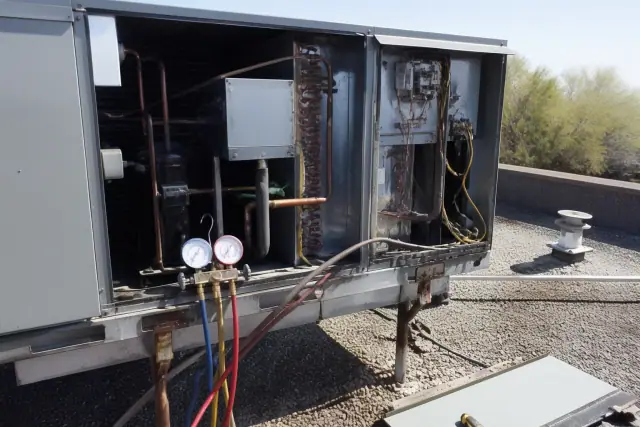
HVAC technician performing a seasonal tune-up on a commercial rooftop unit in Mesa, AZ.

We diagnose compressor failures, refrigerant leaks, failed capacitors, and control-board faults with digital manifold gauges, amp clamps, and combustion analyzers. Common OEM parts carried for major commercial brands can allow same-day completion when the needed part is on the truck.

Explore Service

Commercial HVAC Installation & Replacement

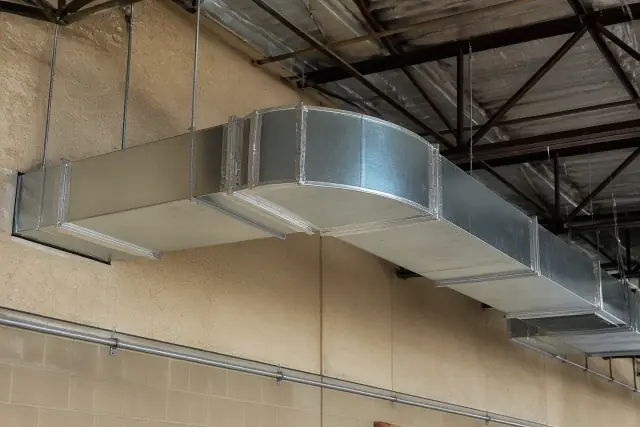
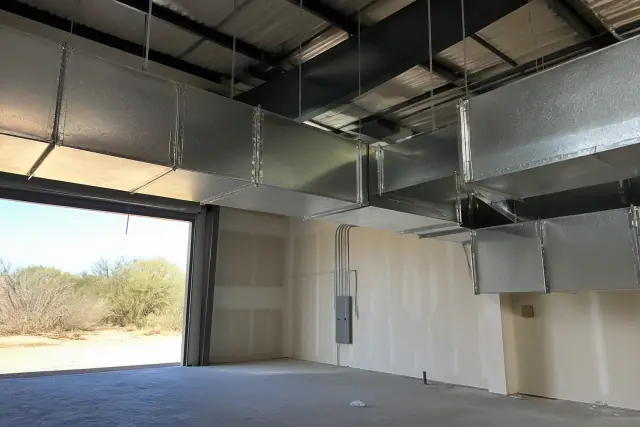
Galvanized steel ductwork installation with foil tape and rod hangers in a Mesa, AZ industrial warehouse.

New construction and equipment replacements use ACCA Manual N load calculations instead of rule-of-thumb sizing. We coordinate City of Mesa permits, rooftop crane sets, and commissioning before handoff.

Explore Service

Commercial HVAC Maintenance

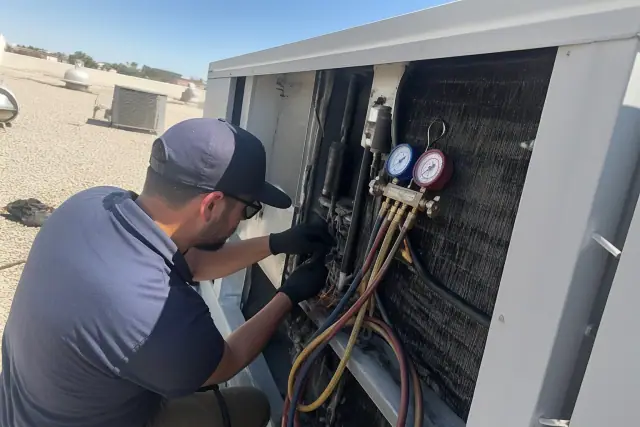
HVAC technician performing a seasonal tune-up on a commercial rooftop unit in Mesa, AZ.

Quarterly or semiannual plans cover coil cleaning, refrigerant-charge verification, belts, bearings, electrical torque, and condensate lines. Facility teams managing mid-size Mesa buildings typically budget $18,000 to $65,000 annually, depending on square footage and equipment count.

Explore Service

Rooftop Unit (RTU) Service & Replacement

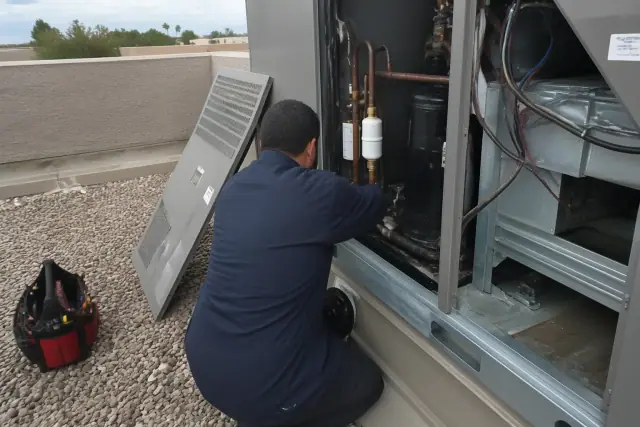
Technician performing a seasonal tune-up on a commercial HVAC rooftop unit in Mesa, AZ.

We service and replace rooftop equipment from 3-ton package systems on small retail buildings to 25-ton units on larger commercial roofs, including curb-adapter work. Mesa RTU replacement typically runs $8,000 to $30,000 per unit based on tonnage, controls integration, and rigging access.

Commercial Refrigeration

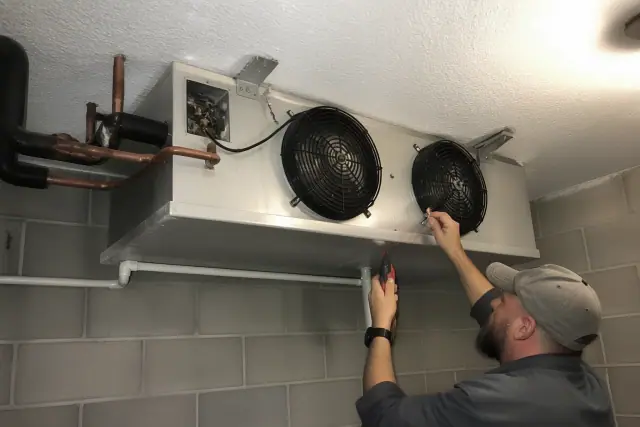
Technician repairing an evaporator coil fan motor in a commercial walk-in cooler in Mesa, AZ.

Service covers walk-in coolers and freezers, reach-in units, ice machines, compressor racks, evaporator coils, defrost timers, and electronic controllers. Our technicians hold EPA Section 608 certification for refrigerant handling, and prompt response matters when summer refrigeration failure can cause product loss within hours.

Commercial Ductwork

Galvanized steel ductwork installation suspended from an industrial ceiling in a Mesa, AZ warehouse.

Manual D duct design, fabrication, static-pressure testing, and mastic sealing help balance airflow across commercial zones. Leaky supply runs in Mesa attic spaces can lose 20 to 30 percent of conditioned air before it reaches a register.

Building Automation & HVAC Controls

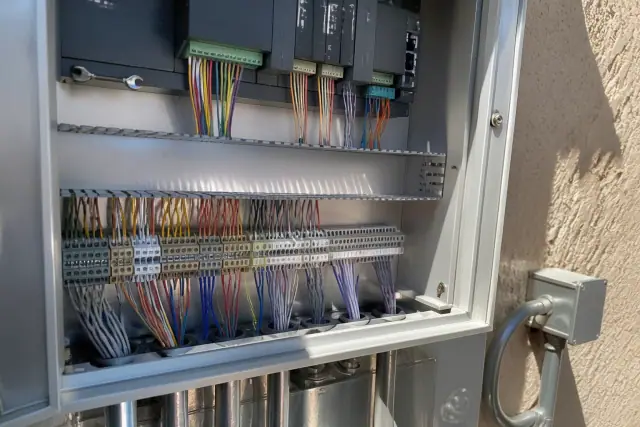
Technician wiring a building automation control cabinet in Mesa, AZ, showing color-coded cables and terminal blocks.

Direct digital controls, commercial thermostats, and BACnet-integrated systems connect multiple rooftop units in one dashboard. Facility managers can schedule setpoints, reduce after-hours runtime, monitor faults remotely, and respond before a tenant complaint arrives.

Commercial Indoor Air Quality

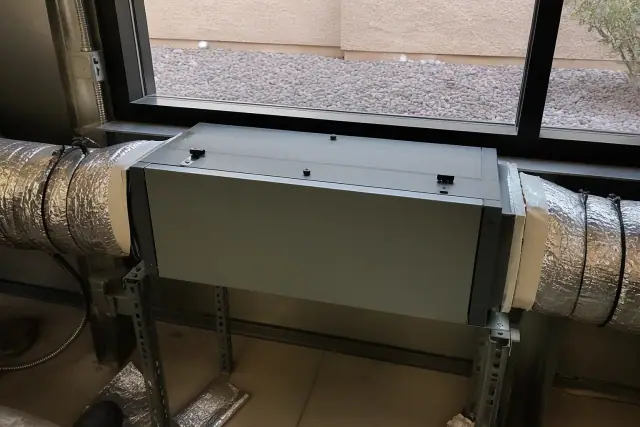
Technician installing a commercial air purification unit into ductwork at a jobsite in Mesa, AZ.

Indoor air quality options include UV air purification, humidity controls, and enhanced filtration for medical offices, schools, and office buildings. These upgrades address the filtration demands created by dust entering Mesa commercial properties.

VRF System Service

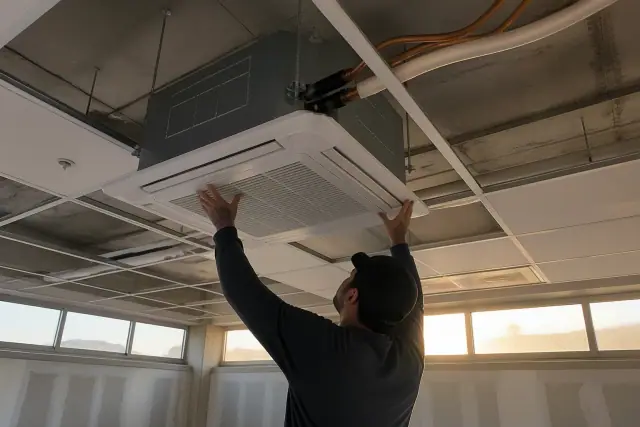
Technician installing a ceiling-cassette VRF unit into a drop ceiling grid at a commercial jobsite in Mesa, AZ.

VRF and ductless commercial systems provide zone-by-zone control for newer medical offices, mixed-use properties, and retrofit projects. Service includes refrigerant-piping diagnostics, branch-controller faults, and outdoor-unit compressor issues specific to VRF architecture.

Restaurant HVAC & Kitchen Ventilation

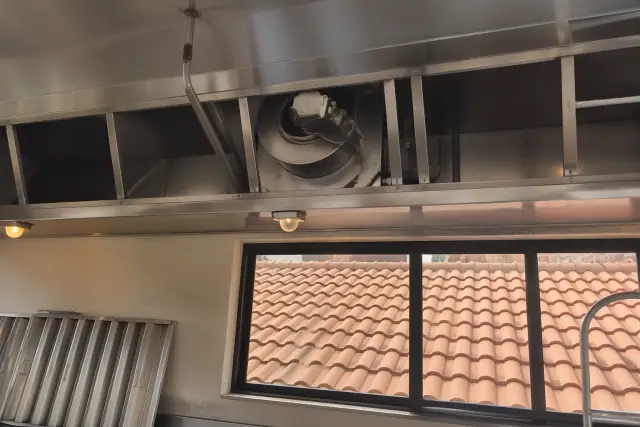
Contractor inspecting a commercial kitchen exhaust hood and blower assembly at a job site in Mesa, AZ.

Restaurant work includes makeup-air units, exhaust-hood fans, grease ducts, and fire-suppression interlocks. We measure airflow and coordinate work around Maricopa County Environmental Services inspection requirements rather than relying on visual estimates.

System Selection

Matching Commercial HVAC to Mesa Facilities

The right configuration depends on roof access, existing ductwork, zoning needs, occupant loads, and controls integration. A five-tenant strip mall, a restaurant kitchen, a medical office, and a high-ceiling warehouse each place different demands on equipment and airflow.

Packaged Rooftop Systems

Packaged units place the compressor, condenser, evaporator, and heating section in one rooftop cabinet. That arrangement is common on Mesa retail and light-commercial roofs because it keeps refrigerant circuits outside the building envelope and provides direct service access.

Split Systems and Heat Pumps

Split systems separate the outdoor condensing unit from an indoor air handler, fitting offices where ductwork routes through a mechanical room instead of a roof curb. Commercial cooling and heat-pump versions can both serve this configuration.

VRF and Ductless Zoning

VRF and ductless systems give tenant spaces independent thermostats without extensive ductwork. They can suit mixed-use buildings, newer medical offices, and retrofits where zone-by-zone control matters.

Repair or Replacement Economics

Commercial equipment typically lasts 15 to 20 years, while well-maintained systems in favorable conditions can reach 20 to 25 years. Equipment pushed beyond its design intent can fail at year eight, so unit age, repair cost, duty cycle, and service history should guide the decision.

Maintenance Schedule and Duty Cycle

Preventive strategies can be 20 to 40 percent more cost-effective than reactive repair over the equipment's life. The Department of Energy estimates that proper operations and maintenance can reduce energy consumption by 5 to 20 percent.

Controls, Ventilation, and Code Fit

Commercial selection must account for three-phase power, VAV zoning, building automation, and ventilation requirements that residential equipment does not address. New installations follow ASHRAE 62.1 ventilation criteria and applicable International Mechanical Code requirements.

Mesa HVAC Issues

Common Commercial HVAC Problems for Mesa Properties

In a city of over 500,000 residents, Mesa's commercial footprint includes light-industrial, retail, medical, and hospitality buildings with heavy cooling demand. Direct sun can push rooftop ambient conditions well above a 115-degree summer air temperature, while desert dust accelerates coil fouling and hard water affects evaporative and hydronic components.

Request HVAC Service

Compressor and Condenser Fan Failure

Long cooling cycles and intense roof exposure strain compressors and condenser-fan motors. A tripped compressor or seized fan can quickly turn into total cooling loss for an occupied business.

Dust-Fouled Coils

Dust from desert lots and development sites coats condenser surfaces faster than it would in a milder market. Restricted coils shed heat poorly, extend run time, and increase stress on cooling components.

Short Cycling and Warm Air

Short cycling or warm supply air can point to refrigerant undercharge, a failed TXV, restricted airflow, or a controls issue. A full diagnostic separates the symptom from the actual equipment fault.

Electrical and Control Faults

Failed capacitors, worn contactors, control-board faults, and breaker trips can stop a packaged or split system without warning. Commercial troubleshooting checks measured electrical loads and safety controls before parts are replaced.

Leaky Ductwork and Uneven Zones

Supply leakage and poor static-pressure balance waste conditioned air and create hot and cold zones. Testing the run, sizing ducts correctly, and sealing joints with mastic address the airflow path instead of masking it at the thermostat.

Kitchen Exhaust and Makeup-Air Imbalance

A kitchen exhaust hood must remove grease-laden vapors while the makeup-air unit replaces that volume without pulling conditioned air from the dining room. Poor balance can raise utility costs and contribute to hood-cleanliness or airflow findings during inspection.

Commercial HVAC Qualifications

Why Mesa Businesses Choose Commercial HVAC Specialists

Commercial work requires training beyond residential equipment swaps. Phoenix Commercial HVAC operates as a licensed Arizona commercial HVAC contractor, our technicians carry EPA Section 608 certification, and our work addresses equipment built for continuous commercial duty.

Mesa Commercial Expertise

Our approach accounts for Mesa's extended cooling season, dusty roof exposure, and mix of retail, medical, restaurant, warehouse, and multi-tenant properties. That local context shapes maintenance scope, equipment access planning, and fault diagnosis.

Documented Diagnostics

Technicians compare refrigerant pressures with manufacturer charts, measure amperage, inspect controls, and verify airflow before recommending work. Findings are documented so facility teams can evaluate the fault and the proposed repair path.

Commercial-Grade Service

We service packaged, split, VRF, refrigeration, controls, and ventilation equipment as connected parts of a commercial facility. Each completed visit is logged to build the service history needed for warranty documentation and future repair-versus-replacement decisions.

Repair Workflow

Our Commercial HVAC Repair Process in Mesa

Every call begins with diagnosis rather than a speculative part swap. The process moves from measured system checks to documented findings, an upfront quote, approved work, and operating verification.

01.

Review Symptoms and Equipment

We start with the reported comfort, refrigeration, airflow, or controls problem and identify the affected equipment. Unit age and available service history help frame the inspection without predetermining the cause.

02.

Measure Pressure, Power, and Airflow

Technicians compare refrigerant pressures with manufacturer charts, verify electrical loads with amp clamps, inspect capacitors and contactors, and check airflow across the coil. These readings isolate the fault before a repair is proposed.

03.

Document Findings and Options

We document what failed and explain the available repair path. If equipment age and condition make another repair difficult to justify, we present replacement as an option instead of continuing to patch an end-of-life unit.

04.

Quote Parts and Labor

Parts and labor are quoted before work starts so the facility team can review the scope. The approved plan reflects the diagnosed fault rather than an open-ended repair.

05.

Complete the Approved Work

Common capacitor, contactor, refrigerant-leak, and control-board repairs can often be completed the same day when the part is in stock. Compressor or evaporator-coil replacements may require ordered parts, and we explain temporary measures that can help keep the space usable.

06.

Verify Operation and Log the Visit

After the repair, we run a full cycle, check subcooling and superheat, verify safety controls, and confirm the space holds setpoint. The completed visit is logged to preserve a useful equipment service history.

Service Outcomes

What Completed HVAC Work Should Deliver for Mesa Businesses

Case Study 1: Repair verification: A completed repair closes with a full operating cycle, subcooling and superheat checks, safety-control verification, and confirmation that the occupied space is holding setpoint.

Case Study 2: Installation handoff: A replacement project moves from Manual N load calculations and Mesa permitting through rooftop coordination and final commissioning before handoff.

Case Study 3: Controls visibility: A configured controls system can centralize schedules, setpoints, and equipment-fault alerts so facility teams can manage multiple rooftop units from one dashboard.

Request Commercial Service

Schedule Commercial
HVAC Service in
Mesa

Tell us which property and equipment need attention, whether the issue involves cooling, heating, refrigeration, controls, ductwork, or ventilation. We will use those details to plan the next diagnostic or project step.

Commercial HVAC Help

Commercial HVAC FAQs for Mesa, AZ

These answers cover equipment lifespan, repair and replacement costs, maintenance, system types, controls, refrigeration, ductwork, and Mesa-area service. Call our team when a facility-specific question requires equipment readings or an on-site diagnosis.

Call Our HVAC Team

Commercial HVAC equipment typically lasts 15 to 20 years. Well-maintained equipment in favorable conditions can reach 20 to 25 years, while Mesa's long cooling season can pull neglected rooftop units toward the lower end of that range.

Commercial systems often use larger tonnage, three-phase power, VAV controls, multiple zones, and building automation. Their continuous duty cycles, duct design, and code requirements call for commercial-specific diagnostic and installation experience.

The $5,000 rule multiplies the estimated repair cost by the unit's age in years. If the result exceeds $5,000, replacement typically makes more financial sense; a $700 repair on a 10-year-old unit produces $7,000. It is a decision guideline that can help avoid repeated spending on aging equipment that may fail again within months.

Plans commonly run quarterly or semiannually, depending on building use, equipment count, and dust exposure. Quarterly coil cleaning, refrigerant checks, and electrical inspections can help equipment move toward the upper end of its service-life range.

Average commercial repair costs run from $243 to $1,567, depending on the failed component. A typical service call lands near $351, while larger compressor or control-board replacements add parts and labor.

RTU replacement typically runs $8,000 to $30,000 per unit. Tonnage, controls integration, curb-adapter needs, and crane or rigging access all affect the project scope.

Yes. Cooling service covers packaged units, split systems, heat pumps, and VRF equipment, while heating work includes gas-furnace sections, electric heat strips, heat exchangers, igniters, and defrost controls on rooftop units.

A maintenance visit can include coil cleaning, refrigerant-charge verification, belt and bearing inspection, electrical torque checks, and condensate-line service. The scope and schedule should reflect the building's equipment count and operating demands.

Mesa facilities commonly use packaged rooftop units, commercial split systems, heat pumps, VRF or ductless equipment, and rooftop units feeding VAV boxes. Selection depends on roof access, existing ductwork, zoning needs, tenant control, and building use.

The diagnostic checks refrigerant pressure against manufacturer data, measures electrical loads with amp clamps, inspects capacitors and contactors, and verifies airflow across the coil. Findings are documented before parts and labor are quoted.

Yes. Service covers walk-in coolers and freezers, reach-in units, ice machines, compressor racks, evaporator coils, defrost timers, and electronic controls. Our technicians carry EPA Section 608 certification for refrigerant handling.

Leaky supply ductwork in a Mesa attic can lose 20 to 30 percent of conditioned air before it reaches the register. Static-pressure testing, Manual D sizing, and mastic-sealed joints help correct waste and uneven temperatures.

Direct digital controls, commercial thermostats, and BACnet integration can coordinate multiple rooftop units from one dashboard. Facility managers can schedule setpoints, monitor faults remotely, and reduce unnecessary after-hours runtime.

Service can cover makeup-air units, exhaust-hood fans, grease ducts, airflow balance, and fire-suppression interlocks. These systems must clear grease-laden vapors while replacing exhaust volume without pulling conditioned air from the dining room.

Mesa coverage includes Dobson Ranch, Downtown Mesa, Eastmark, Las Sendas, Red Mountain, and the Fiesta District. Service also reaches Tempe, Chandler, Gilbert, Queen Creek, Apache Junction, and properties bordering the Salt River Pima-Maricopa Indian Community, with account needs guiding the radius for multi-location businesses.