Proudly serving Phoenix, Mesa, Scottsdale, Tempe, Chandler, Glendale & surrounding areasCall or Text 24/7: 480-300-4493
Aerial drone view of a residential neighborhood with Saguaro cacti and stucco homes in Phoenix, AZ.

Commercial HVAC Repair & System Troubleshooting in Phoenix, AZ

Phoenix Commercial HVAC provides commercial HVAC repair, installation, and maintenance for businesses across Phoenix and the metro area. Our crews service rooftop units, refrigeration equipment, ductwork, building automation controls, indoor air quality systems, VRF equipment, and restaurant kitchen ventilation. We work with office towers, retail centers, restaurants, warehouses, medical offices, and other commercial facilities.

Commercial systems here can operate through weeks of 115-degree ambient temperatures, accelerating wear on compressors, condenser fan motors, and control boards. A failure can push an unconditioned commercial space past 100 degrees within a couple of hours, threatening occupants, inventory, and refrigerated products. We are a licensed, bonded, and insured HVAC contractor working under Arizona Registrar of Contractors requirements, and our technicians carry EPA Section 608 certification for refrigerant handling. Diagnostics begin with amp draw, refrigerant pressure, airflow, and control-fault readings so the repair addresses the actual failure.

Our commercial experience spans downtown Phoenix office towers, Ahwatukee retail centers, Arcadia restaurants, and industrial buildings near the I-17 corridor, with project planning that accounts for building age, roof access, and City of Phoenix Development Services Department permitting.

Phoenix Commercial HVAC provides commercial HVAC repair throughout Phoenix and the metro area, including Scottsdale, Tempe, Mesa, Chandler, and Glendale.

★ ★ ★ ★ ★4.9/5.0 Customer Rating · 31 Years of HVAC Experience · Thousands of Commercial Systems Serviced · Licensed, Bonded & Insured · Serving Commercial & Industrial Properties

Commercial HVAC Repair & Support

What Does Commercial HVAC Repair Cover?

Commercial HVAC repair starts with a structured review of electrical supply, refrigerant pressures, airflow, and control logic. Digital manifold gauges, amp-draw readings, combustion analyzers, and equipment fault codes help isolate the cause before parts are replaced, keeping a $300 repair from becoming a $1,800 invoice because unrelated parts were changed.

Repairs may involve contactors, capacitors, control boards, compressors, condenser fan motors, evaporators, blowers, belts, thermostats, duct connections, or refrigerant leaks. The same diagnostic discipline applies to rooftop package units, heat pumps, VRF systems, walk-in coolers, display cases, and restaurant ventilation equipment.

For urgent calls, dispatch priority reflects occupancy risk and equipment criticality, with restaurants, medical offices, and server rooms moving to the front of the queue. Stocked service vehicles carry common contactors, capacitors, and control boards so many failures can be resolved during the first visit.

Benefits of Structured Commercial HVAC Repair

A measured repair process separates electrical, refrigerant, airflow, and controls issues instead of treating every no-cooling call as the same problem. That distinction supports clearer recommendations and helps avoid replacing components that are still operating correctly.

  • Electrical and control checks come before mechanical part replacement
  • Electronic leak detection precedes refrigerant recovery or recharge
  • Airflow measurements reveal coil, blower, belt, and duct restrictions
  • Fault-code reviews identify thermostat, control board, and automation conflicts
  • Critical facilities receive dispatch priority based on occupancy and equipment risk
  • Common electrical and control parts are stocked on service vehicles
  • Written scopes show equipment, labor, ductwork, and permitting factors
  • Performance records track discharge temperatures and amp draws over time
Commercial HVAC Services

Core Commercial HVAC Services

Commercial properties need coordinated support across cooling, heating, refrigeration, ventilation, controls, and maintenance. Our services cover urgent failures, planned replacement, preventive care, and specialized food-service equipment throughout the Phoenix metro area.

Emergency Commercial HVAC Repair

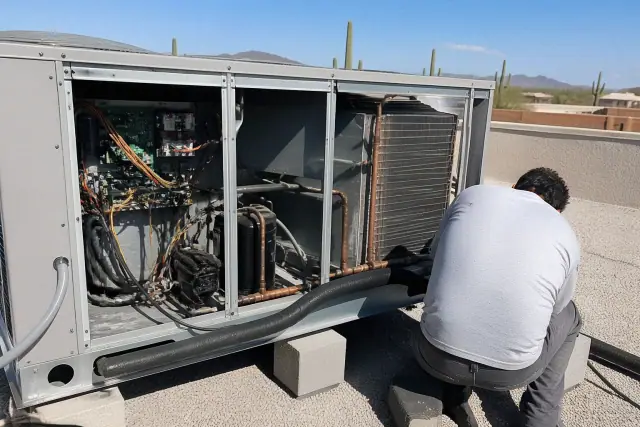
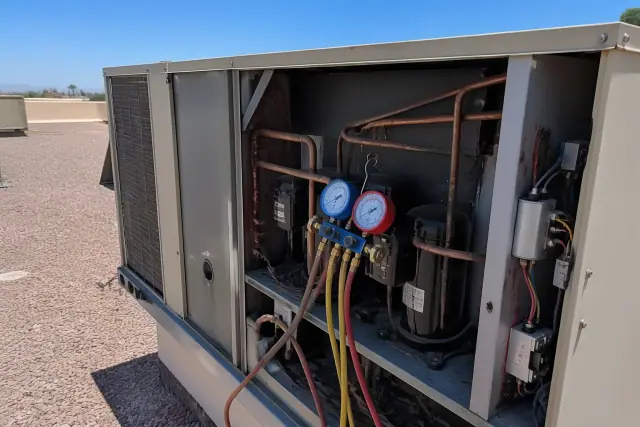
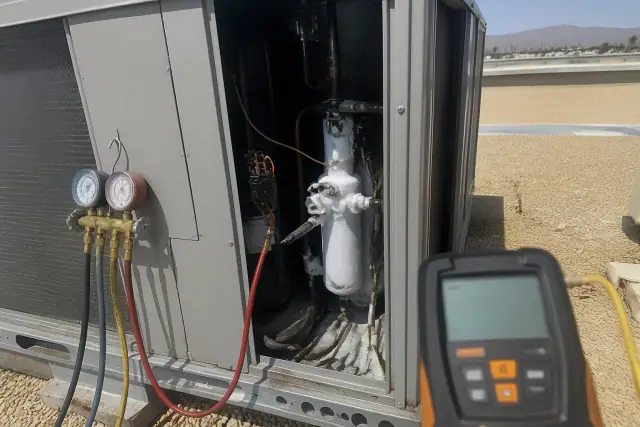
Rooftop commercial HVAC unit with a frosted expansion valve and refrigerant gauges during a repair in Phoenix, AZ.

Our technicians are available 24/7 for compressor lockouts, control failures, and down commercial systems. Calls are prioritized by occupancy and equipment risk, and the first assessment covers amp draw, refrigerant pressure, and control-board fault codes.

Request Estimate

Rooftop Unit Service and Replacement

Technician performing a seasonal HVAC tune-up on a commercial rooftop unit in Phoenix, AZ.

Packaged rooftop units are evaluated for compressor, condenser, blower, belt, refrigerant, and control problems. When replacement is the better path, tonnage is matched to an actual heat-load calculation while roof access, structural load, electrical capacity, and curb modifications are reviewed before equipment is ordered.

Request Estimate

Commercial Refrigeration Repair

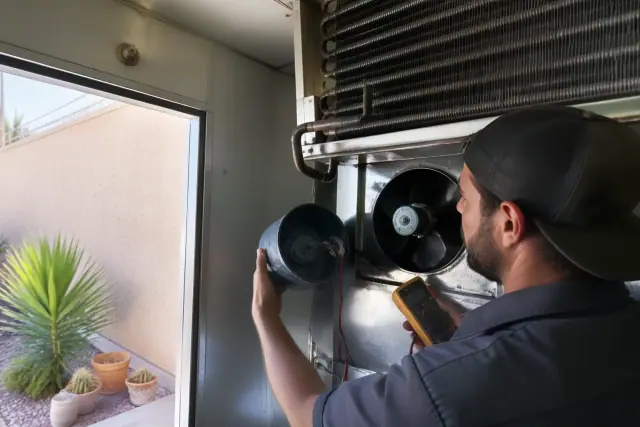
A technician repairing a walk-in cooler evaporator fan motor in Phoenix, AZ.

Walk-in coolers, freezers, display cases, ice machines, prep coolers, and beverage systems receive service tailored to food-service operating conditions. Technicians inspect evaporator coils, door gaskets, compressors, condensers, defrost cycles, and thermostat calibration to address continuous operation and temperature-control failures.

Request Estimate

Commercial HVAC Installation and Replacement

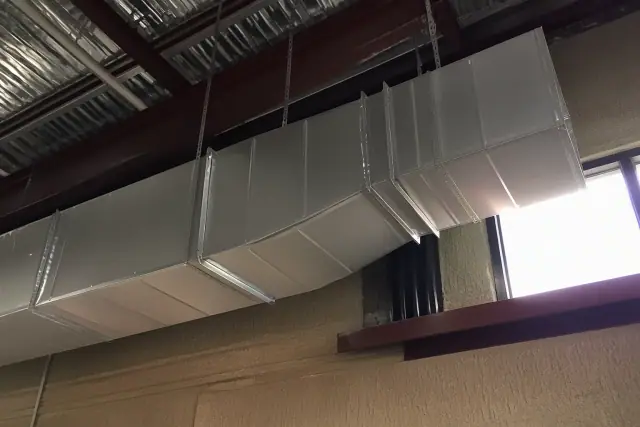
Galvanized steel ductwork hanging from an industrial ceiling in Phoenix, AZ.

Commercial replacement planning considers tonnage, system type, building access, electrical service, Phoenix building-code requirements, and SEER2 minimums. Rooftop package units, split systems, VRF systems, and commercial mini splits are compared against the building's actual load and zoning needs before a written scope is prepared.

Request Estimate

Preventive Commercial HVAC Maintenance

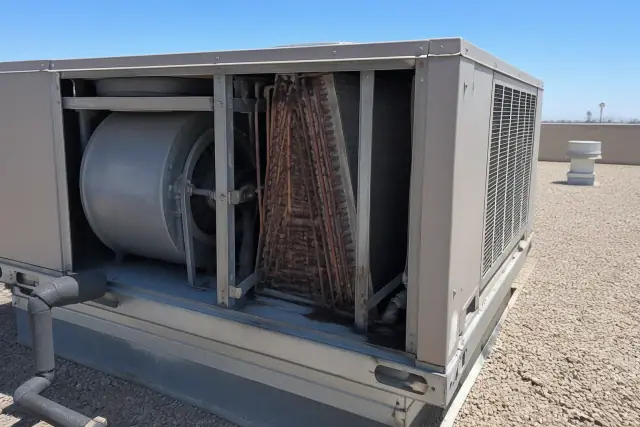
HVAC rooftop unit with internal blower and copper coils exposed during maintenance on a gravel roof in Phoenix, AZ.

Scheduled programs include coil cleaning, belt and bearing inspection, refrigerant-charge verification, electrical connection torque checks, and filter changes. Unit age, refrigerant type, repair frequency, discharge-air temperature, and amp draw are tracked to support replacement planning before peak-season failure.

Request Estimate

Restaurant HVAC and Kitchen Ventilation

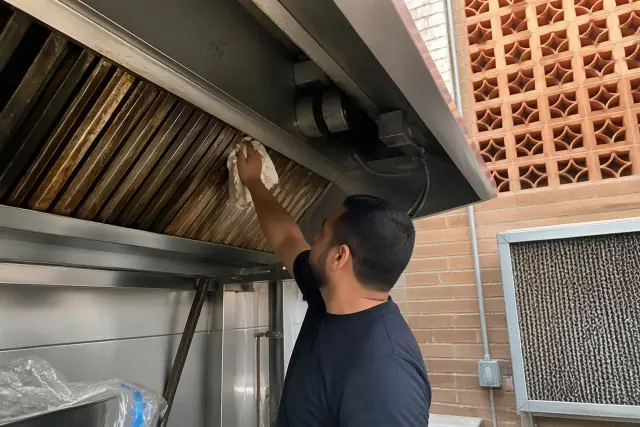
Contractor cleaning grease from a commercial kitchen exhaust hood filter in Phoenix, AZ.

Restaurant service covers exhaust fan motors, hood duct connections, fire-suppression tie-ins, makeup-air sizing, grease-duct inspection, humidity control, and filtration. Work is coordinated around Maricopa County Environmental Services, City of Phoenix Fire Department, and NFPA 96 requirements that apply to commercial grease-exhaust systems.

Request Estimate
Equipment and Controls

Commercial HVAC Equipment & Options

The right commercial system depends on heat load, tenant zoning, duct availability, roof access, electrical capacity, and equipment criticality. These equipment and control categories allow repair or replacement recommendations to match the way each property actually operates.

Commercial HVAC technician performing a rooftop unit repair on a gravel roof in Phoenix, AZ.

Rooftop Package Units

Packaged RTUs simplify roof penetrations and service access for many Phoenix commercial buildings. Repair and replacement decisions account for heat-load calculations and the practical details of placing equipment on the roof.

  • Tonnage matched to calculated building heat load
  • Roof structural load and access review
  • Electrical service capacity verification
  • Curb-adapter and ductwork modification planning
  • Crane placement included in the written scope
Request Estimate
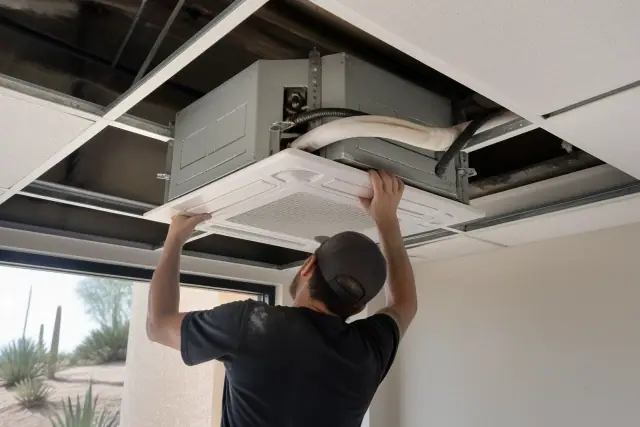
Technician installing a VRF ceiling cassette unit at a commercial HVAC worksite in Phoenix, AZ.

VRF and Commercial Mini Split Systems

Variable refrigerant flow systems suit multi-tenant and mixed-use buildings that need independent zone control without dense traditional ductwork. Commercial mini splits can serve small additions, server rooms, and spaces added after original construction where extending ducts is impractical.

  • Independent control for multiple tenant zones
  • Branch controllers sized to manufacturer specifications
  • Refrigerant line sets matched to the system design
  • Zone commissioning with airflow verification
  • Superheat checks completed before handoff
Request Estimate
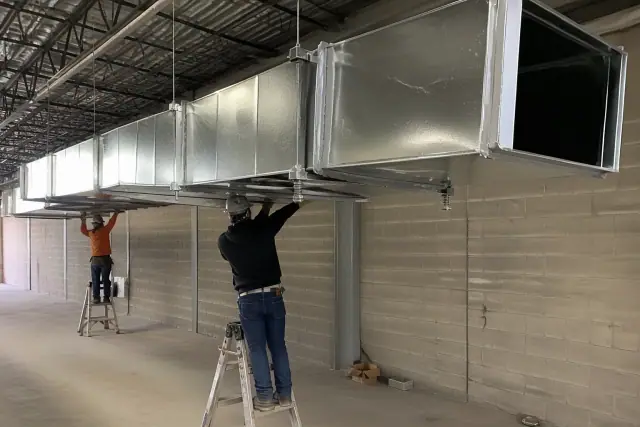
Galvanized steel ductwork installation with mastic tape and vibration hangers in a Phoenix, AZ warehouse.

Commercial Ductwork

Duct design and repair affect comfort, airflow, and how much conditioned air reaches occupied rooms. Sheet-metal and fiberglass systems are sized, tested, and sealed with attention to static pressure and leakage.

  • Sheet-metal duct fabrication and installation
  • Fiberglass duct system installation
  • SMACNA static-pressure sizing and testing
  • Joint sealing to reduce conditioned-air leakage
  • Supply-duct review in attic and roof spaces
Request Estimate
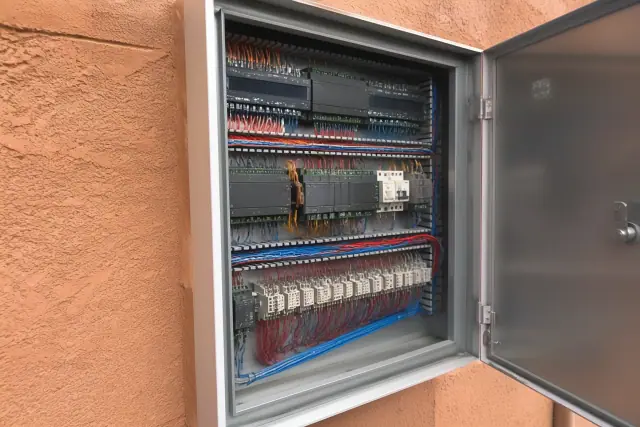
Building automation control cabinet with color-coded wiring inside a commercial building in Phoenix, AZ.

Building Automation and HVAC Controls

Building automation connects equipment schedules, zone setpoints, and fault alerts so facility teams can manage operation across occupied and unoccupied periods. Controls service also resolves thermostat programming, control-board faults, and scheduling conflicts that can resemble mechanical failure.

  • Building automation platform programming
  • Occupied and unoccupied scheduling
  • Zone setpoint management
  • Equipment fault alerts and code review
  • Commercial thermostat installation and repair
Request Estimate
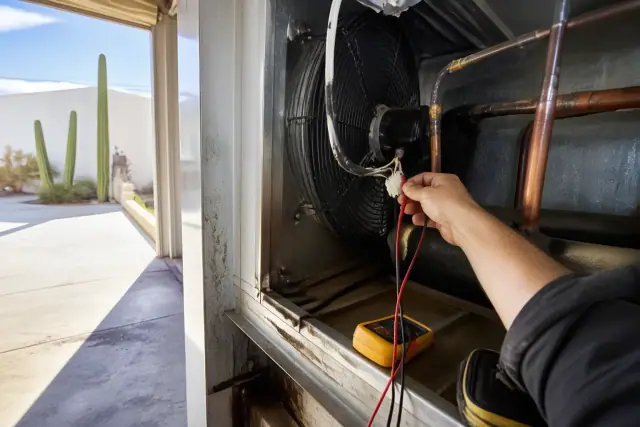
Technician testing a commercial refrigeration fan motor at a jobsite in Phoenix, AZ.

Commercial Refrigeration and Air Quality

Food-service cooling and indoor air quality often interact with hot kitchens, grease-laden air, cooking odors, and building pressure. Coordinated refrigeration, filtration, humidity-control, exhaust, and makeup-air work addresses those connected conditions.

  • Walk-in cooler and freezer service
  • Display-case defrost and thermostat calibration
  • Ice machine, prep cooler, and beverage-system support
  • Humidity-control and filtration upgrades
  • Kitchen exhaust and makeup-air coordination
Request Estimate
Finding Your Right Fit

Choosing the Right Commercial HVAC Approach

A repair-versus-replacement recommendation should reflect equipment age, repair frequency, refrigerant type, remaining efficiency life, tonnage, duct condition, roof access, and electrical capacity. The operating needs of a 1,500 square foot retail space differ from those of a 20,000 square foot warehouse, so the scope must follow the building rather than a one-size-fits-all equipment choice.

Certified Refrigerant Handling

EPA Section 608-certified technicians handle diagnosis, recovery, leak checks, and recharge work on R-410A, R-407C, and legacy R-22 systems. Electronic leak detection is completed before refrigerant is added to a system that may still be losing its charge.

Phoenix Commercial Experience

Experience with offices, retail centers, restaurants, and industrial buildings helps our crews account for building age, tenant schedules, roof access, and the sustained heat and dust that affect Salt River Valley equipment. That commercial focus also informs dispatch decisions when refrigerated products, medical spaces, or server-room loads are at risk.

Measured, Standards-Based Work

Digital manifold gauges and combustion analyzers support equipment diagnostics, while airflow and static-pressure testing guide duct decisions. Installations and testing follow applicable ASHRAE and SMACNA standards instead of relying on the size of the unit being removed.

What Sets Us Apart

Why Choose Phoenix Commercial HVAC for Repairs?

Our licensed, bonded, and insured commercial HVAC team combines 24/7 availability with risk-based dispatch, measured diagnostics, code-aware installation planning, and written scopes. Recommendations account for the building, system condition, refrigerant, repair history, and operational priorities before repair or replacement work begins.

Request an HVAC Estimate

Rooftop Unit Shutdowns

Compressor lockouts, failed condenser fan motors, worn contactors, weak capacitors, and control-board faults can take a packaged RTU offline. These failures are especially consequential during July and August, when sustained high head pressure pushes aging compressors hardest.

Refrigerant Leaks and High Pressure

Low charge can indicate a leak, while dirty condenser coils and Phoenix dust or haboob conditions can raise head pressure and shorten compressor life. Pressure readings, coil inspection, and electronic leak detection distinguish these conditions before recovery, repair, or recharge.

Airflow and Blower Failures

Evaporator restrictions, failed blower motors, worn belts, and leaky supply ducts can produce a no-cooling complaint even when the refrigerant charge is correct. Airflow measurement and duct-joint testing identify losses before conditioned air reaches occupied space.

Heating Section Faults

Commercial package units may use heat strips, gas-fired furnace sections, or heat-pump operation on cold desert mornings. Heat exchangers, igniters, gas valves, reversing valves, defrost controls, refrigerant charge, thermostats, and schedules all require review when heating mode fails.

Commercial Refrigeration Downtime

Poor door seals, dirty evaporator coils, defrost faults, thermostat drift, and compressor or condenser problems can force coolers and freezers to run continuously. In hot kitchens, that added load can quickly put refrigerated inventory and food-safe temperatures at risk.

Kitchen Ventilation Imbalance

An exhaust hood without properly sized makeup air can create negative pressure and pull unconditioned outdoor air through door and window gaps. Grease buildup, failed exhaust motors, duct-connection problems, and fire-suppression tie-in faults also affect kitchen operation and inspection readiness.

Repair Workflow

Our Commercial HVAC Repair Process

Commercial HVAC troubleshooting follows a deliberate sequence so the recommendation reflects measured equipment conditions. The process moves from risk and electrical supply through refrigerant, airflow, controls, scope, and final performance verification.

01.

Risk-Based Dispatch

The initial call identifies the equipment, symptoms, occupancy, and operational risk. Restaurants, medical offices, server rooms, and refrigeration failures are prioritized when downtime can compound quickly.

02.

Electrical and Controls Check

Technicians check electrical supply, control voltage, breakers, fuses, amp draw, thermostat settings, building automation schedules, and control-board fault codes. This step can expose a power or programming problem before mechanical work begins.

03.

Refrigerant Diagnostics

Refrigerant pressures are compared with manufacturer target superheat and subcooling values. If charge is low, electronic leak detection comes before recovery, repair, or recharge by an EPA Section 608-certified technician.

04.

Airflow and Component Inspection

Airflow across coils is measured while belts, bearings, blowers, evaporators, condensers, filters, and duct leakage are inspected. These checks determine whether poor heat transfer or restricted air movement is driving the symptom.

05.

Clear Repair Scope

The findings support a repair or replacement recommendation based on equipment age, refrigerant, repair frequency, access, and system condition. Written scopes separate equipment, labor, ductwork modifications, crane needs, electrical work, and permitting factors when they apply.

06.

Performance Verification

After the work, operating values such as airflow, discharge-air temperature, refrigerant performance, and amp draw are verified. Maintenance customers receive documented readings that can reveal trends across later visits.

Restore Reliable Operation

Schedule a Commercial
HVAC Repair
Assessment

Tell Phoenix Commercial HVAC which system is down, what symptoms you are seeing, and how the failure affects your building. We will use that operating context to prioritize the call and begin a measured commercial HVAC diagnosis.

Commercial HVAC Help

Commercial HVAC Repair FAQs

These answers cover repair-versus-replacement decisions, service pricing factors, troubleshooting, maintenance timing, installation requirements, and equipment support for Phoenix commercial properties.

Call Our HVAC Team

The $5,000 rule multiplies the unit's age by the estimated repair cost; a result above $5,000 can point toward replacement. A 12-year-old rooftop unit with a $500 compressor repair produces $6,000 under this calculation. Refrigerant type, remaining efficiency life, and repair frequency should also be considered rather than using the rule alone.

Average standard commercial HVAC service costs locally run from $1,772 to $2,115, while individual repairs can range from roughly $134 to over $2,000 depending on the failure. Full replacement costs more and varies with tonnage, system type, ductwork condition, roof access, crane placement, curb modifications, and electrical upgrades. A written, itemized scope shows which factors drive the total.

Troubleshooting begins with electrical supply and control voltage, followed by refrigerant pressures, airflow, and control logic. Technicians compare superheat, subcooling, and compressor amp draw with manufacturer targets and nameplate specifications. Building staff can verify thermostat settings and breakers, but refrigerant and electrical diagnostics belong with a licensed technician using proper equipment.

Commercial leases typically define whether the landlord or tenant is responsible for HVAC maintenance, while new equipment must meet current energy-code requirements enforced through local building departments, including applicable SEER2 minimums. Federal EPA Section 608 rules require certified technicians for refrigerant handling. Restaurant kitchen ventilation may also involve Maricopa County requirements and NFPA 96 fire-code provisions.

Most commercial systems should be serviced at least twice a year, once before cooling season and once before heating season. High-use buildings such as restaurants may benefit from quarterly visits, while Phoenix rooftop units should receive semiannual attention at minimum because summer operation and dust load coils quickly. Refrigeration equipment tied to food safety may need more frequent inspection.

A capacitor or contactor replacement can often be completed during the same visit, typically within one to two hours after the technician arrives and finishes diagnostics. A compressor replacement or major refrigerant-leak repair can require a full day or longer. Part availability for older equipment and roof-access conditions also affect the schedule.

Check for active Arizona licensing, EPA Section 608 certification for refrigerant handling, and commercial project experience that matches your building type. Ask how the contractor separates electrical, refrigerant, airflow, and controls faults and whether the proposed scope accounts for access, equipment criticality, and permitting. Phoenix Commercial HVAC is licensed, bonded, insured, and focused on commercial systems.

Rooftop units can face weeks of 115-degree ambient temperatures and an extended cooling season. From April through October, cooling failures dominate service calls, while dust and haboob conditions can foul condenser coils, raise head pressure, and shorten compressor life. Pre-summer coil cleaning and refrigerant checks address those local stresses.

Dispatch priority is based on occupancy risk and equipment criticality. Restaurants, medical offices, server rooms, and failed refrigeration systems move forward because downtime can threaten food, sensitive equipment, or occupied conditions. The initial call should identify the affected equipment, symptoms, and operational impact.

Yes. EPA Section 608-certified technicians service R-410A, R-407C, and legacy R-22 equipment using pressure checks, electronic leak detection, recovery, and recharge procedures. Refrigerant type also matters when comparing continued repair with replacement.

A preventive program can include coil cleaning, belt and bearing inspection, refrigerant-charge verification, electrical connection torque checks, and filter changes on a scheduled interval. Properly maintained systems in this climate typically run 15-20% more efficiently than neglected equipment. Annual program budgets generally fall between $0.15 and $0.30 per square foot, depending on equipment count and building size.

Design starts with building heat load, required tonnage, zoning, duct condition, roof structural load, electrical capacity, and equipment access. Phoenix permitting and current SEER2 requirements also affect the plan. A quick same-size swap can preserve short-cycling or comfort problems when the old unit was not matched to the actual load.

Phoenix Commercial HVAC works with office towers, strip retail centers, restaurants, industrial buildings, distribution centers, medical offices, server rooms, grocery stores, and convenience stores. Supported systems include packaged RTUs, furnaces, heat pumps, VRF equipment, mini splits, ductwork, building automation, walk-in coolers, display cases, kitchen ventilation, and indoor air quality equipment. Service extends across Phoenix, Scottsdale, Tempe, Mesa, Chandler, Glendale, and the broader Maricopa County metro area.