Typical Annual Cost
Most contracts fall within an annual range shaped by building size, equipment count, and the chosen coverage tier rather than one flat per-unit fee.
At Phoenix Commercial HVAC, the practical starting range for a Phoenix metro commercial HVAC maintenance contract is $0.15 to $0.30 per square foot annually, or roughly $500 to $10,000 per year. An accurate quote still depends on an in-person review of rooftop units, ductwork, and controls because a strip mall along Camelback Road and a distribution warehouse near Sky Harbor carry very different maintenance loads.
Most contracts fall within an annual range shaped by building size, equipment count, and the chosen coverage tier rather than one flat per-unit fee.
RTU quantity, VRF equipment, refrigeration, controls, visit frequency, parts coverage, and emergency provisions all change technician time and contract risk.
Ask for a line-item proposal that names each visit, maintenance task, covered part, refrigerant charge, emergency term, and reporting requirement.
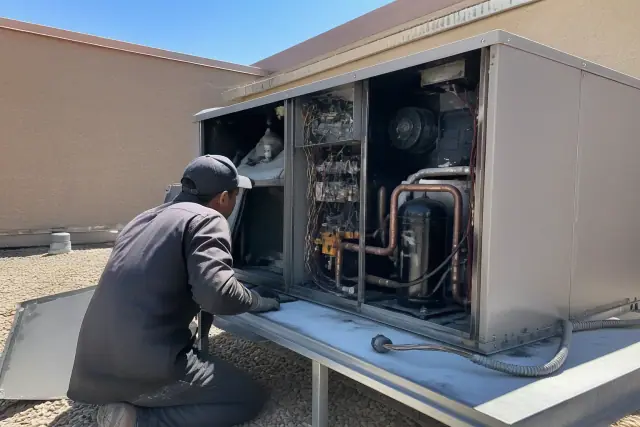
A 5,000-square-foot retail property with two packaged rooftop units. This illustrates why straightforward access and a small equipment count lower the maintenance load.
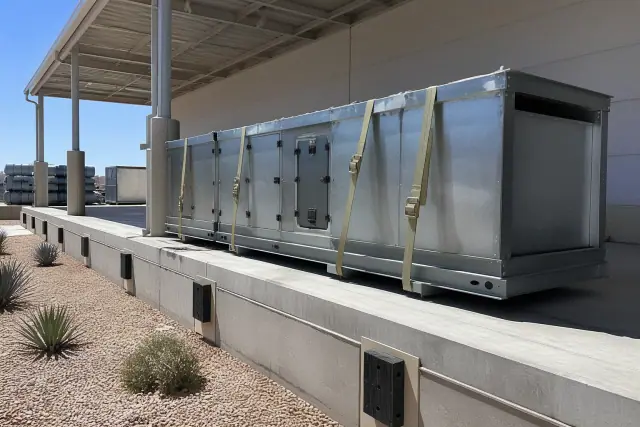
A 50,000-square-foot warehouse with a dozen RTUs and a walk-in cooler. The larger inventory and mixed equipment make each visit more involved.
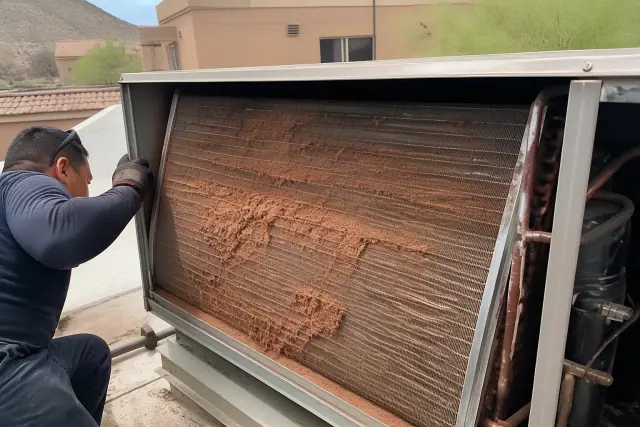
Condenser coils exposed to Sonoran Desert dust, monsoon debris, and strong UV. These conditions increase cleaning needs and degrade insulation and gasket material.
$500 to $1,500 per year generally buys two to four scheduled visits, filter changes, and visual inspection without parts coverage.
$1,500 to $5,000 annually adds refrigerant checks, minor components such as capacitors and contactors, and priority scheduling over non-contract work.
$5,000 to $10,000 or more can include covered parts and labor, emergency-response commitments, and building automation monitoring for issues such as a failing economizer damper.
Comprehensive tiers can reach $0.65 per square foot, while VRF systems, commercial refrigeration, and restaurant kitchen ventilation use separate pricing structures; restaurant exhaust may also require NFPA 96-compliant cleaning schedules.
| Pricing basis | Typical annual cost | Typical scope |
|---|---|---|
| Small building under 10,000 square feet | $500 to $2,000 | Two to four straightforward rooftop units |
| Mid-sized facility from 10,000 to 50,000 square feet | $1,000 to $10,000 | Multiple units, with controls or refrigeration pushing toward the high end |
| Basic coverage tier | $500 to $1,500 | Two to four visits, filters, and visual inspection; parts excluded |
| Standard coverage tier | $1,500 to $5,000 | Refrigerant checks, minor parts, and priority scheduling |
| Premium coverage tier | $5,000 to $10,000 or more | Covered parts and labor, emergency terms, and often controls monitoring |
| Square-foot pricing | $0.15 to $0.30 per square foot | Standard annual coverage; premium tiers can reach $0.65 per square foot |
The contract price bundles scheduled labor, inspection scope, and coverage promises into one annual or quarterly amount. A well-defined scope can include coil cleaning, filter replacement, refrigerant charge verification, belt and bearing checks, tightened electrical connections, and a written report after every visit; ductwork balancing or leak inspection may be bundled for larger accounts, while indoor-air-quality items such as UV lamp replacement or ionization checks usually appear as add-ons.
Phoenix commonly experiences 100+ days above 100 degrees Fahrenheit in a year, which extends compressor run time and accelerates wear, refrigerant leaks, and capacitor failures. July and August emergency terms carry added weight when a rooftop failure can occur on a 115-degree day. Monthly, quarterly, or biannual visit frequency changes labor directly, while travel between areas such as Deer Valley and Ahwatukee, roof access, equipment age, tonnage, refrigerant type, and current condition also shape the proposal.
To price a contract, inventory each unit's type, tonnage, age, refrigerant, and condition, then define the visit schedule, consumables, parts caps, and emergency terms. To weigh repair against replacement, the $5,000 rule multiplies equipment age by repair cost: a 12-year-old unit facing a $500 repair produces $6,000, which points toward replacement as a discussion starter rather than an automatic decision. Preventive strategies are typically 20 to 40 percent more cost-effective over equipment life than reactive repair-only approaches, and a well-maintained rooftop unit in this climate typically lasts 15 to 20 years compared with 10 to 12 years for a neglected unit.
Gather the equipment count, approximate square footage, and recent repair history before requesting proposals. A rooftop and mechanical-room walkthrough makes it possible to compare a line-item scope based on actual building conditions instead of a generic square-foot formula.