Safe Refrigerator Range
The accepted range is 32°F to 40°F (0°C to 4°C), while a 34°F to 38°F target provides a useful safety buffer.
A commercial refrigerator should hold at 40°F (4°C) or below; Phoenix Commercial HVAC recommends a 34°F to 38°F working range so normal door openings and compressor cycles do not push food above that ceiling. This guide explains safe settings for reach-ins, prep tables, undercounter units, walk-ins, and freezers serving restaurants, grocers, and healthcare kitchens across the Salt River Valley.
The accepted range is 32°F to 40°F (0°C to 4°C), while a 34°F to 38°F target provides a useful safety buffer.
Treat 40°F as the maximum, not the setpoint, because door traffic, kitchen heat, and compressor cycling can quickly erase the remaining margin.
Check the warmest zone near the door with a calibrated NIST-traceable thermometer and log the reading twice daily.
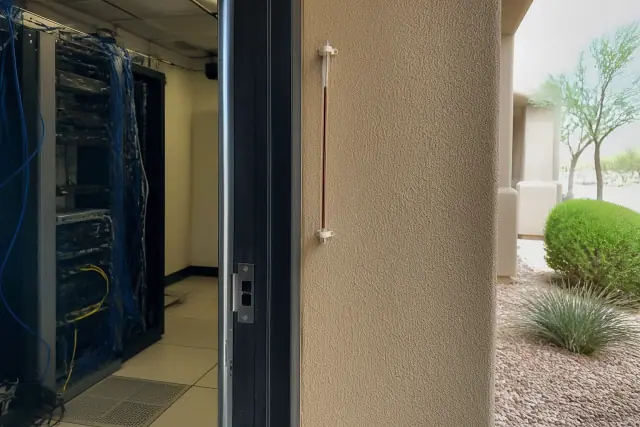
A calibrated thermometer in the cabinet's warmest zone near the door. That position reveals temperature drift that a controller display may miss.
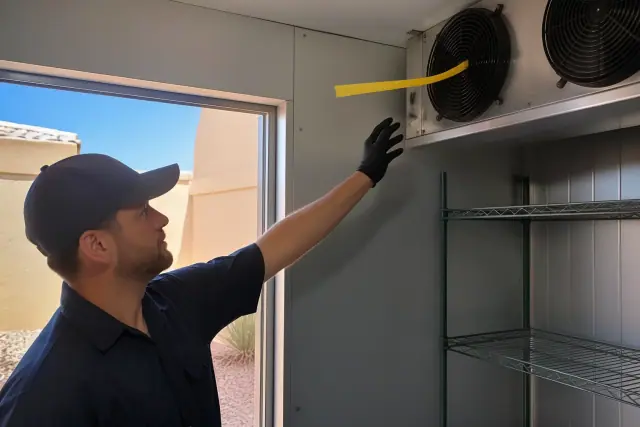
Readings at the floor, center, and ceiling of a walk-in cooler. Multiple points expose temperature stratification in a large box.
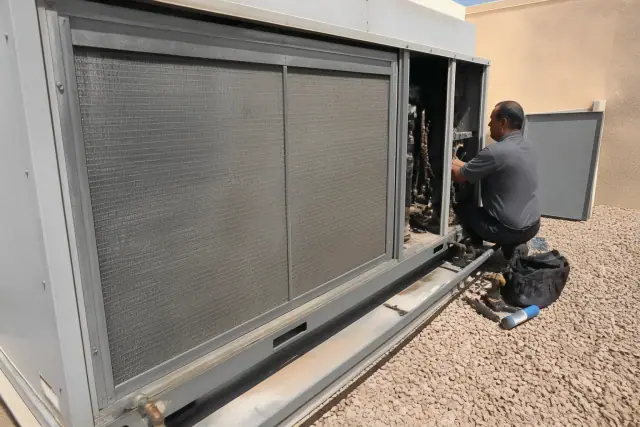
A clean condenser coil beside one restricted by dust. Coil condition directly affects heat rejection during Phoenix's hottest months.
Set most reach-ins and prep tables to 36°F to 38°F so the cabinet stays below the 40°F compliance line during normal operation.
Keep commercial freezers at 0°F (-18°C) or lower; a -2°F to 0°F setting can add a buffer for ice cream, long-term storage, and heavy summer loads.
The 40°F to 140°F danger zone supports rapid bacterial growth; Salmonella and Listeria can double in number in as little as 20 minutes. Perishable food should reach 40°F or below within two hours.
A 37°F reading is safe, 40°F should trigger a check, and 41°F is tolerable only briefly. Repeated readings from 42°F to 45°F require diagnosis; a steady 43°F should be addressed within 24 to 48 hours, while 45°F calls for immediate corrective action.
| Food or Equipment | Recommended Temperature | Operating Note |
|---|---|---|
| Raw meat and poultry | 32°F-36°F | Keep at the colder end of the refrigerator range. |
| Dairy | 34°F-38°F | Maintain a stable cabinet temperature. |
| Produce | 35°F-40°F | Avoid settings below 34°F for chill-sensitive items. |
| Prepared and ready-to-eat food | 36°F-40°F | Do not exceed the 40°F holding ceiling. |
| Commercial freezer | 0°F (-18°C) or lower | A slightly colder -2°F-0°F setting can add a load buffer. |
The controller setting is only a starting point; measured cabinet temperature determines whether food is held safely. New reach-ins and undercounter units may arrive set between 38°F and 41°F, so adjust toward 36°F to 38°F, allow 24 hours for stabilization, and confirm the result with logged thermometer readings rather than relying on the display alone.
Kitchen temperatures above 90°F and Phoenix outdoor heat that regularly exceeds 110°F raise condenser head pressure and reduce efficiency, while monsoon dust can clog coils. Worn door gaskets, evaporator frost, blocked airflow, failed fans, low refrigerant charge, compressor faults, and control-board problems also cause drift. Phoenix winters rarely fall below 40°F ambient, so seasonal calibration still matters, and rooftop-adjacent walk-ins may need careful ductwork separation and condenser placement where HVAC and refrigeration share mechanical space.
Should every refrigerated food use the same target? No: raw proteins belong near 34°F, dairy within 34°F to 38°F, produce within 35°F to 40°F, and prepared food within 36°F to 40°F; chill-sensitive produce can be damaged below 34°F. Should a walk-in be checked at only one point? No, readings near the floor and ceiling can differ, so verify several locations. Do local inspections consider these readings? Maricopa County Environmental Services inspectors check unit temperatures during routine food-safety inspections, and repeated violations can lead to re-inspection or a closure order.
If a reach-in, prep table, undercounter refrigerator, or walk-in cannot hold its setpoint after gasket and coil checks, request a commercial refrigeration diagnostic. A spring inspection can verify controller calibration, airflow, coil condition, and mechanical operation before Phoenix summer load peaks; refrigerant, compressor, and control-board faults require a licensed technician working within EPA Section 608 and Arizona Registrar of Contractors requirements.