$14,000-$55,000 Installed
That range covers most 5-20 ton commercial rooftop unit replacements entering 2026. Unit size sets the baseline, while roof and building conditions determine where a project lands within it.
For Phoenix property owners, Phoenix Commercial HVAC typically sees commercial rooftop unit replacement budgets of $14,000-$55,000 installed, with tonnage, crane access, roof-curb work, duct transitions, electrical changes, and gas piping shaping the final quote. Understanding what the installed number includes helps owners Review Options before Phoenix demand peaks from May through September.
That range covers most 5-20 ton commercial rooftop unit replacements entering 2026. Unit size sets the baseline, while roof and building conditions determine where a project lands within it.
Crane reach, curb dimensions, ductwork, electrical service, gas piping, controls, and structural needs can move the price substantially. Phoenix roof temperatures that regularly exceed 150°F can also shorten service life and make equipment condition more important.
A useful quote should separate equipment, rigging, curb adaptation, duct and electrical work, refrigerant, disposal, startup, and controls integration. The site review should also identify the required City of Phoenix mechanical permit and International Mechanical Code considerations.
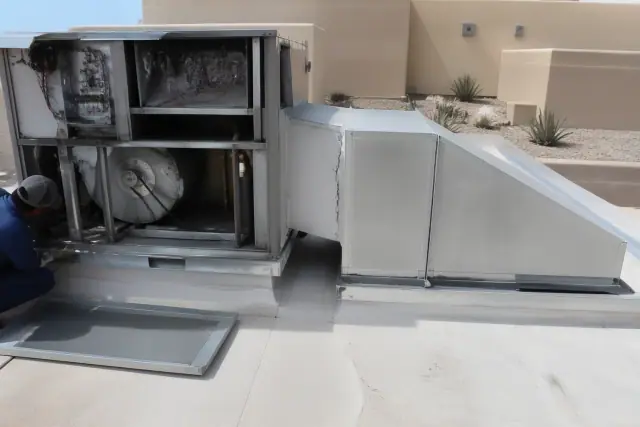
The packaged unit, its curb footprint, and the supply and return openings on a Phoenix commercial roof. A mismatch can require custom sheet-metal transitions or structural curb work.
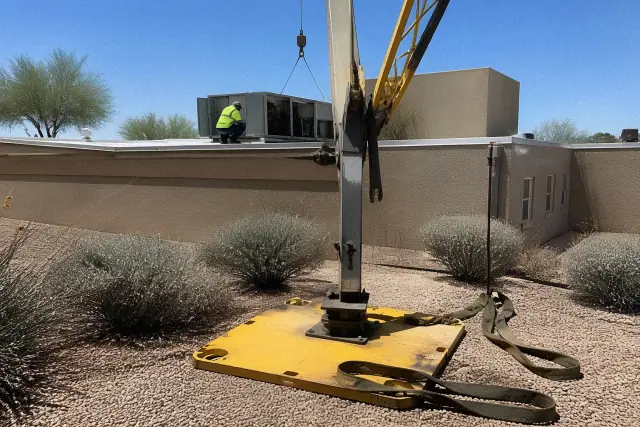
The lift path from the staging area to the roof, including building height and boom reach. These access conditions explain why a downtown high-rise lift differs from a single-story commercial property.
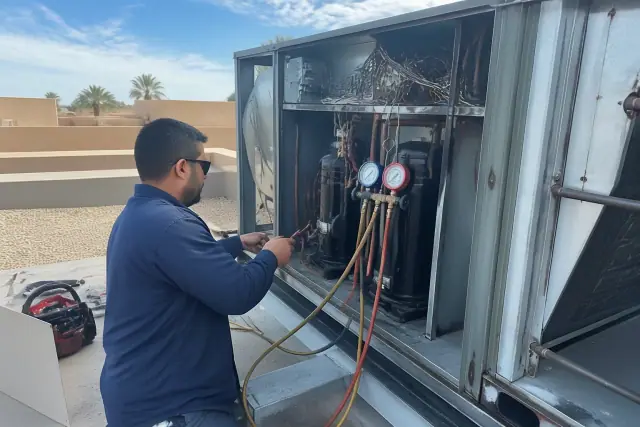
A technician verifying airflow, static pressure, superheat, subcooling, and control operation after installation. Commissioning confirms that the new unit and building systems work together before turnover.
Through 2024, smaller packaged units under 10 tons ran about $2,800-$3,500 per ton installed, while larger 15-20 ton systems ran about $1,800-$2,500 per ton because fixed mobilization and startup costs were spread over more capacity.
Phoenix commercial sizing often uses roughly one ton per 300-350 square feet, compared with 350-400 square feet in milder climates. A 4,000-square-foot office may therefore need about 12 tons in Phoenix rather than 10 tons in a cooler region.
Labor generally accounts for 20-30% of project cost. A mid-size swap typically takes two to three technicians one to two full days, with more time needed for new duct transitions or building automation integration.
The $5,000 rule multiplies unit age by repair cost; a result above $5,000 points toward replacement. A compressor can represent 30-40% of a full unit's price, and compressor replacement alone can run $2,500-$5,000.
Typical total: $14,000-$55,000 installed for most 5-20 ton replacements quoted entering 2026.
| Cost component | Typical share or range | What changes it |
|---|---|---|
| Packaged equipment | 40-60% of the installed total | Tonnage, efficiency tier, and equipment configuration |
| Installation labor | 20-30% of the project | Curb fit, roof reinforcement, duct transitions, and controls |
| Crane | $1,500-$4,000 | Building height, boom reach, and access |
| Old-unit removal and disposal | $500-$1,500 for removal; disposal adds a few hundred dollars | Unit size, roof access, and refrigerant recovery |
| Ductwork transitions | $1,000-$5,000 | Supply and return dimensions that do not match the new curb |
| Electrical changes | $500-$3,000 | Disconnects, breakers, conduit, and panel capacity |
| Additional refrigerant | $200-$800 | R-454B conversion needs or long line sets |
| Startup and commissioning | $300-$800 | Airflow balancing, controls integration, and performance checks |
An installed price covers more than the cabinet: it includes rigging off the old RTU, setting the replacement on an existing or new curb, refrigerant work, duct transitions, electrical disconnects, applicable gas piping, and startup commissioning. On a $20,000 installed job, the packaged equipment itself might account for about $9,000-$12,000, with the balance paying for the work and materials needed to put it into service.
A single-tenant retail property may need one 10-ton RTU, while a strip mall or restaurant may require three to five units, separate permits, and more crane coordination. Complex 15-ton natural-gas installations with extensive piping, structural upgrades, or interconnected equipment can push beyond $60,000-$100,000. The 2023 Department of Energy efficiency changes moved equipment toward higher SEER2 and EER2 ratings, and the 2025 EPA AIM Act refrigerant transition toward R-454B pushed comparable quotes about 8-12% above the prior year for buildings replacing older R-22 or early R-410A units. Entering 2026, equipment lead times plus copper and steel costs remain major variables, especially during Phoenix's May-through-September demand season.
Does a Phoenix RTU replacement need a permit? Yes, it requires a mechanical permit through the City of Phoenix Development Services Department. How long should an RTU last? The national range is typically 15-20 years, but Phoenix heat can shorten that to roughly 12-18 years without diligent maintenance, including service at least twice a year. When is repair still reasonable? It often makes sense below 10 years of age when the repair is under 30% of replacement value; once a unit reaches 12-15 years or a repair approaches 30-50%, replacement becomes the stronger comparison, and a 20-year-old unit is generally beyond its expected service life.
Share the unit tonnage, building height, roof access, curb condition, ductwork, electrical service, gas requirements, and controls details. A site review can turn the broad installed range into an itemized replacement scope for the property.